Occupational conditions
The demands, events, environments, and expectations that continuously enter the system.
HOMSM / The developing theory
HOMSM understands mental health as an emergent property of a dynamic adaptive system—not as a collection of isolated symptoms.
Central proposition
Employees continuously adapt to changing occupational conditions. Adaptive capacity, protective resources, and adaptive processes shape what happens next.
Burnout, distress, recovery, resilience, and well-being emerge from these interactions.
01 / The architecture
The model is organized into distinct levels so that each question can be asked clearly: what exists, how it behaves, how it changes, what emerges, and how it can be tested.
The demands, events, environments, and expectations that continuously enter the system.
The current potential to adapt, cope, regulate, recover, and maintain functioning.
The cognitive, emotional, behavioral, social, and recovery processes through which adaptation occurs.
Organizational, personal, and social supports that strengthen, preserve, or restore capacity.
Psychological and occupational patterns that emerge from the system over time.
Outcomes reorganize future conditions, resources, capacity, and demands.
Figure 2.1
All components interact reciprocally. The model is dynamic, with multiple feedback loops operating over time.
Read the source documents↗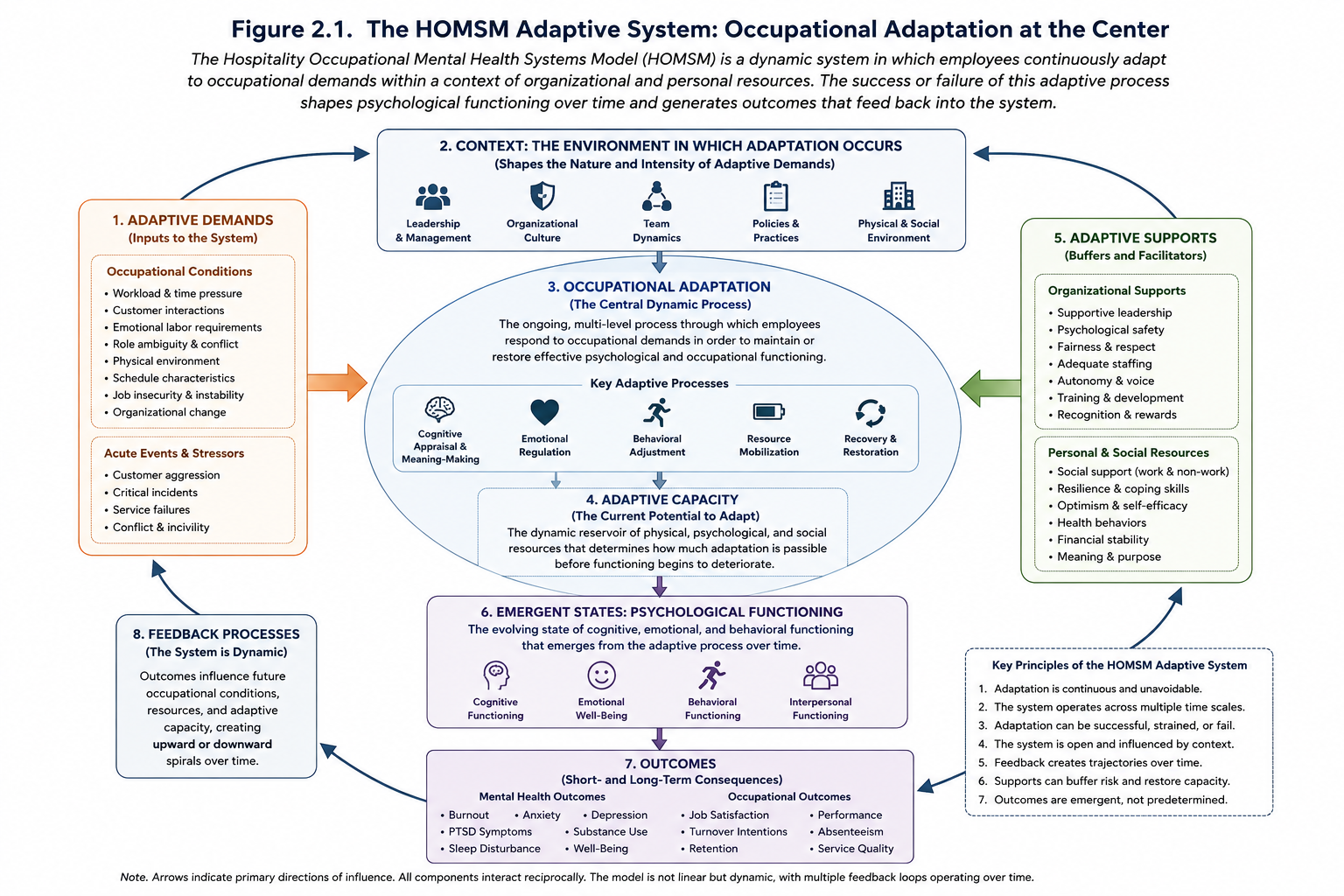
02 / Theory development
The foundational conceptual architecture of the model.
The entities, relationships, principles, and assumptions that define the system.
A disciplined organization of validated constructs.
Causal pathways, adaptive cycles, feedback, and emergence.
Ways theory can inform organizational action.
Formal propositions and hypotheses for empirical testing.
A working claim
The goal is not the largest theory. It is the smallest theory capable of explaining the adaptive reality.
See how it is developed↗